Showing posts with label Japanese Lifestyle. Show all posts

Cosplay

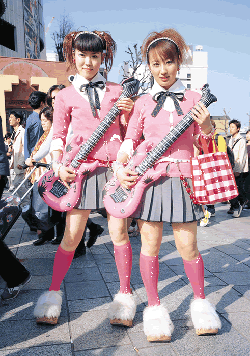
Cosplay (コスプレ, kosupure), short for "costume play", is a type of performance art in which participants don costumes and accessories to represent a specific character or idea. Characters are often drawn from popular fiction in Japan, but recent trends have included American cartoons and Sci-Fi as well as other pop-culture. Favorite sources include manga, anime, tokusatsu, comic books, graphic novels, video games, hentai and fantasy movies. Any entity from the real or virtual world that lends itself to dramatic interpretation may be taken up as a subject. Inanimate objects are given anthropomorphic forms and it is not unusual to see genders switched, with women playing male roles and vice versa.


Cosplayers often interact to create a subculture centered around role play. A broader use of the term cosplay applies it to any costumed role play in venues apart from the stage, regardless of the cultural context.


Cosplayers typically come from the ranks of otaku--that is, fans of Japanese comic books, known as manga. They gather at public events such as comic-book and video game trade shows, as well as at dedicated cosplay parties at nightclubs or amusement parks. In Japan teenagers gather with like-minded friends in places like Tokyo's Harajuku district to engage in cosplay. Since 1998 Tokyo's Akihabara district has contained a large number of cosplay cafés, catering to devoted anime and cosplay fans. The waitresses at such cafés dress as game or anime characters; maid costumes are particularly popular. In areas outside of Japan, cosplay is primarily done at manga and anime conventions.

The single largest event featuring cosplay is the semiannual doujinshi market, Comiket. This event, held in Japan during summer and winter, attracts hundreds of thousands of manga fans. Thousands of cosplayers congregate on the roof of the exhibition center. The largest event for cosplayers outside Asia is the annual San Diego Comic-Con held in the California city in the USA.


Cosplayers in Japan refer to themselves as reiyā (レイヤー, reiyaa); pronounced "layer". Those who photograph players are called cameko, short for "Camera Kozō" or "Camera Boy". Originally the cameko give prints of their photos to players as gifts. Increased interest in cosplay events both on the part of photographers and cosplayers willing to model for them have led to formalisation of procedures at events such as Comiket. Photography takes place within a designated area removed from the exhibit hall.

Cosplay at fan events likely originated in Japan in 1978. Cosplay nevertheless gets a mixed reception in Japan even today. Events in districts such as Akihabara draw many cosplayers, yet there is no shortage of people in Japan who regard cosplay as a frivolous endeavor.

Harajuku

Harajuku (原宿 "meadow lodging") is the common name for the area around Harajuku Station on the Yamanote Line in the Shibuya ward of Tokyo, Japan.


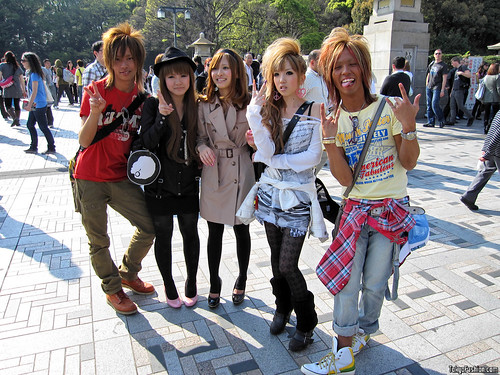
Every Sunday, young people dressed in a variety of styles including gothic lolita, visual kei, and decora, as well as cosplayers spend the day in Harajuku socializing. The fashion styles of these youths rarely conform to one particular style and are usually a mesh of many. Most young people gather on Jingu Bridge, which is a pedestrian bridge that connects Harajuku to the neighboring Meiji Shrine area.

Harajuku is also a fashion capital of the world, renowned for its unique street fashion. Harajuku street style is promoted in Japanese and international publications such as Kera, Tune, Gothic & Lolita Bible and Fruits. Many prominent designers and fashion ideas have sprung from Harajuku and incorporated themselves into other fashions throughout the world.

Harajuku is also a large shopping district that includes international brands, its own brands, and shops selling clothes young people can afford.


Harajuku as it is now traces its roots to the end of World War II. U.S. soldiers and their families began to occupy the area known as Harajuku. It became an area where curious young people flocked to experience a different culture.

In 1958, Central Apartments were built in the area and were quickly occupied by fashion designers, models, and photographers.[8] In 1964, when the Summer Olympics came to Tokyo the Harajuku area was further developed, and the idea of “Harajuku” slowly began to take a more concrete shape.

After the Olympics the young people who hung out in the area, frequently referred to as the Harajuku-zoku, or the Harajuku tribe, began to develop a distinct culture and style unique to different groups and the area. From this distinct style grew the culture of Harajuku as a gathering ground for youths and as a fashion mecca.

The term "Harajuku Girls" has been used by English-language media to describe teenagers dressed in any fashion style who are in the area of Harajuku. This fashion infuses multiple looks and styles to create a unique form of dress. The cyber-punk look takes its influence from gothic fashion and incorporates neon and metallic colors. However, it isn't as popular as it was in the 1990s.


Kogal


Kogal (コギャル) is a fashion that involves wearing an outfit based on a Japanese school uniform, but with a shortened skirt, loose socks, and often dyed hair and a scarf as well. The phenomenon was prominent in the 1990s, but has since declined. The word "kogal" is anglicized from kogyaru, a contraction of kôkôsei(高校生ギャル) gyaru(ギャル) (high school gal). The girls refer to themselves as gyaru (gals), although this word is applied to several other fashion looks as well.


Aside from the pinned-up skirt and the loose socks, or rusu sokusu, kogals favor platform boots, makeup, and Burberry scarves. They may also dye their hair brown and get artificial suntans. They have a distinctive slang peppered with English words. They are often, but not necessarily, enrolled students. Centers of kogal culture include the Harajuku and Shibuya districts of Tokyo, in particular Shibuya's 109 Building. J-pop singer Namie Amuro promoted the style. Kogals are avid users of photo booths, with most visiting a least once a week, according to non-scientific polls. While critics condemned the gyaru as shallow, materialistic, and devoted to conspicuous consumption, admirers describe them as, "kindhearted, active young women in exuberant health, the women of today."


Kogals are identified primarily by looks, but their speech, called コギャル語 (kogyarugo), is also distinctive. Her boyfriend is an イケ面 (ikemen?) (cool dude) who is naturally 超かわいい (chou-kawaii?) (totally cute). She, meanwhile, will gyaru-yatte (do the gal thing) by buying her gyaru-fuku (gal clothes) at a gyaru-kei shoppu (gal-style shop) thereby gyaru-do appu no tame ni (increasing her degree of galness), unless of course she simply cannot find anything that isn't 超マジでむかつく (chou maji de mukatsuku?)(real super nauseating). In a land obsessed with self-sacrifice and group identity, the gals proclaim, biba jibun (long live the self).

Gals words are often created by contracting Japanese phrases or by literal translation of an English phrase, i.e. without reordering to follow Japanese syntax.Gal words may also be created by adding the suffix -ingu (from English "-ing") to verbs, for example ゲッティング (gettingu?)(getting). Roman script abbreviations are popular, for example "MM" stands for maji de mukatsuku (really disgusting). "MK5" stands for マジでキレる5秒前 (maji de kireru 5 byoumae?), meaning "on the verge of [lit. five seconds away from] going ballistic." Another feature of gal speech is the suffix -ra, meaning "like" or "learned from," as in アムラー (Amura?) (like singer Namie Amuro).